In music timing is everything! I think that timing is even more important that pitch. So, it’s important that we cover the basics of it sooner rather than later.
As a simple example, anyone can sing Happy Birthday - you don’t really need to hit the right notes in order to sing the song. But if you sing the words in a weird timing everyone will know that you messed up. Try singing the song and pausing for different lengths at random points - and see if you can still say that you’re singing the song.
A general piece of advice I give to musicians is not to get flustered if you play the wrong notes, just focus on coming back in on the next correct note at the right time. As long as you pick back up at the right time, most people won’t really pay attention to the mistake.
Music tempo is defined in terms of beats per minute (bpm). Think of a drum beating.
A bpm of 60 means 1 beat per second. Tap your hand on your leg 1 time per second, and you can get a feel for how slow that is. In fact, in can be challenging to play music that slow. Try to sing Happy Birthday pronouncing each sylable with every tap. Hap-py Birth-day to you…
Now tap your hand on your leg at 120 bpm, or 2 times per second, and sing Happy Birthday at that tempo.
A music note is not just the pitch, but it’s also the length that the pitch is played. So, when you’re reading music, you’re not just reading the name of the note, but also the duration of the note.
A music note has an anatomy. It’s simple. Every note has a head. Some notes have a stem. And some of those notes have a flag.

And silence is a part of music, so when the music requires you to be silent for a given duration it will show what’s called a rest, which come in a variety of shapes.
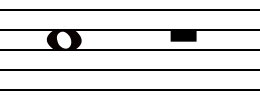
The whole note is just a hollow head, and it’s the only note that does not have a stem.
The whole rest is a filled in rectangle that hangs below the line. If you use your imagination, it kind of looks like a bowl. You can remember it as “whole rest, bowl rest.”
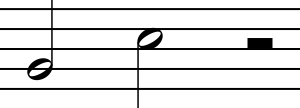
The half note is half the duration of a whole note, and looks like the whole note with a stem.
The half rest is a filled in rectangle that sits above the line. If you use your imagination, it kind of looks like a top hat. You can remember it as “half rest, hat rest.”
Also notice that when a note is placed below the middle staff line the stem points up, and when a note is placed on the middle staff line or above the stem points down.

The quarter note is half the duration of a half note, and has a solid head with a stem.
The quarter rest looks kind of like a lightning bolt. Sorry, I don’t have any clever rhyme to remember this one by - but you will see it often enough that you will learn it pretty quickly.
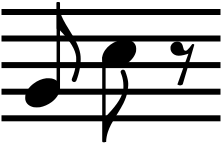
The eighth note is half the duration of a quarter note, and looks like a quarter note with a flag.
The eighth rest kind of looks like a 7.

The sixteenth note is half the duration of an eighth note, and looks like an eighth note with an extra flag.
The sixteenth rest kind of looks like two 7s stacked on top of each other.
There are also 32nd and 64th notes and rests, and they each add an additional flag, or stack an additional 7.
And in order to know how long you should play each of these notes, you need something called a time signature.
A time signature appears next to the cleff and is one number stacked on top of another.
The most common time signature is 4/4.
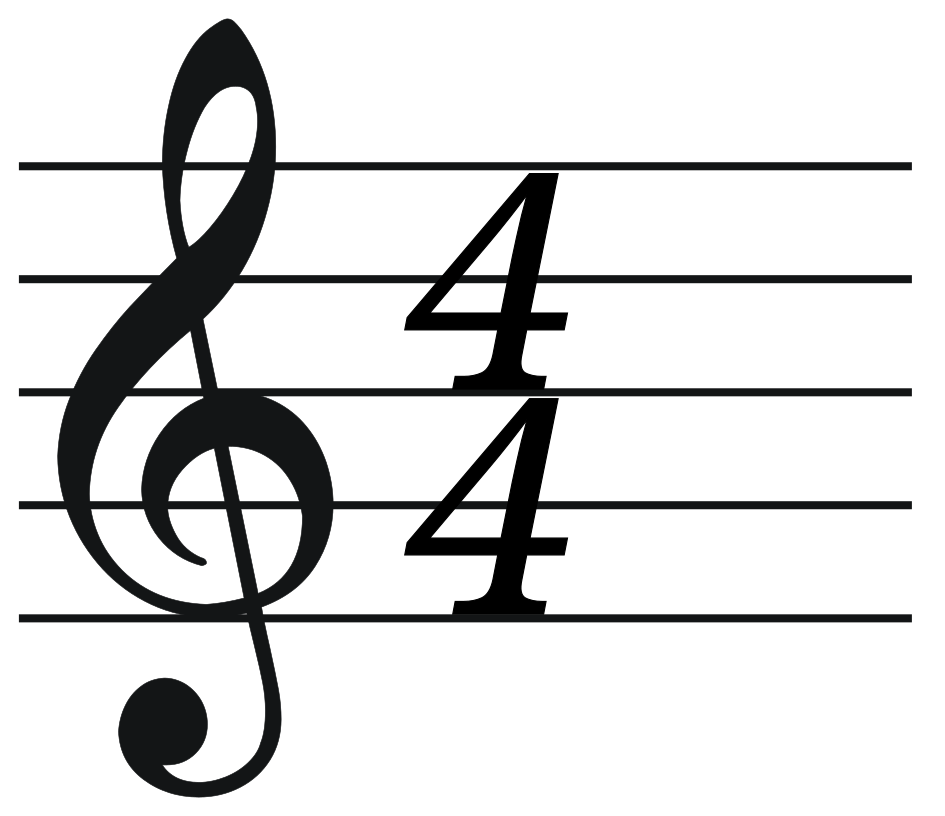
The top number tells you how many beats per measure.
The bottom number tells you what note gets one beat.
So, in 4/4 time, there are 4 beats per measure, and the quarter note gets one beat.

A measure is marked by a vertical line on the staff - called a measure line. A measure can also be called a bar - and the vertical line called a bar line. In this example, there are 8 measures, or bars.
Since there are 4 beats per measure and the quarter note gets one beat, that means that there can only be one whole note per measure (1 whole = 4 quarters), or two half notes per measure (one half = 2 quarters), or 8 eighth notes per measure (1 quarter = 2 eighths).
Of course there can be any combination of these notes that add up to 4 quarters - such as a half note, a quarter note, and two eighths - it’s just a matter of how many notes should fit in a measure.